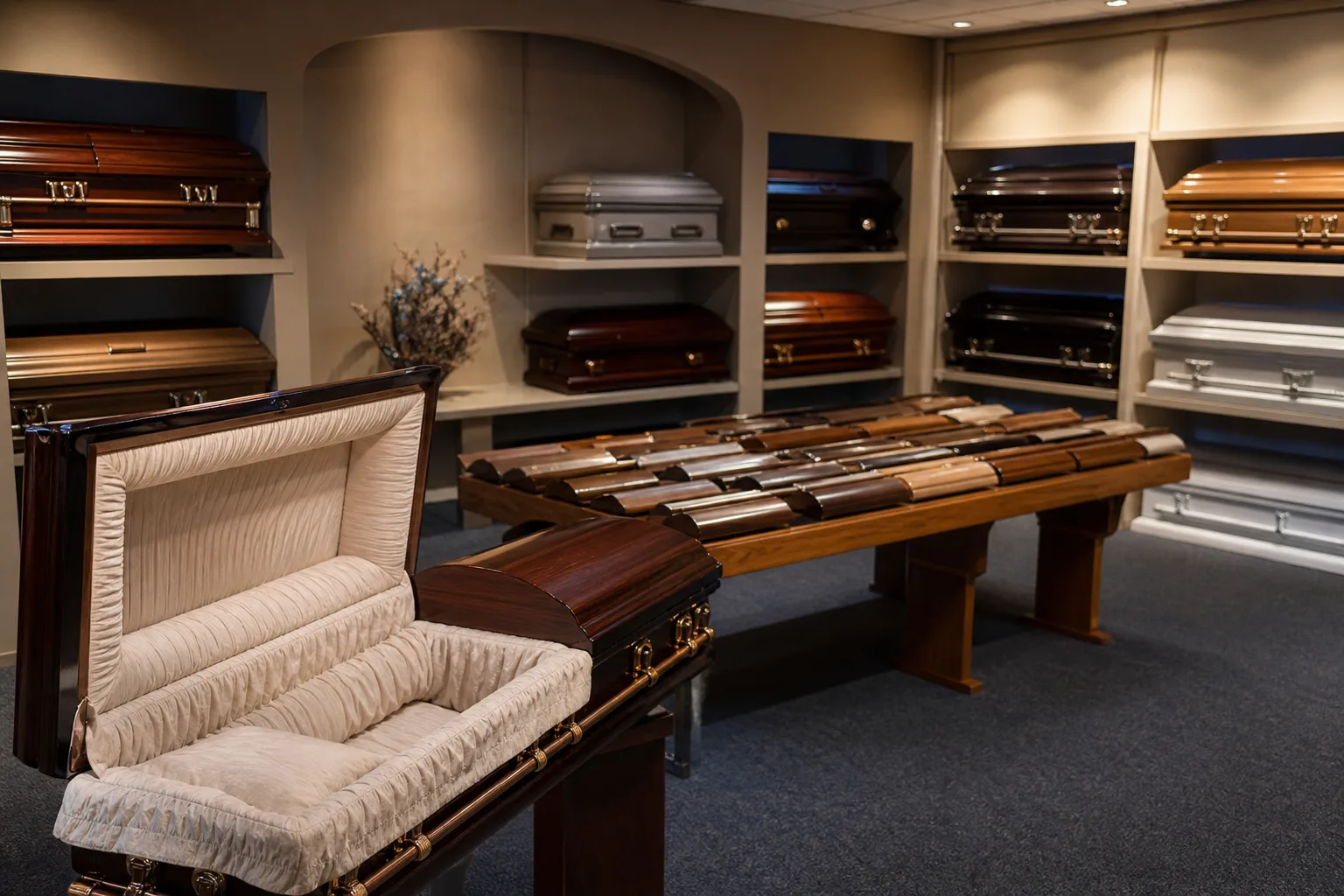
A price sheet gives you one number per model, and that number looks like a single decision. It isn't. Behind it sit four or five separate choices that the manufacturer made before the box ever reached the funeral home, and each of them moved the figure by a different amount. Once you can see the parts, you can tell whether you're paying for the metal, the finish, the handles, the lining, or a rubber gasket, and you can decide which of those you actually care about. That is a far more useful question than whether the total feels high.
Shell material sets the floor, and everything else builds on it
The first fork is metal or wood, and the two price on completely different logic. Metal is sold by gauge and by alloy, so a steel shell is quoted against a scale that runs from thin to thick and then jumps again for stainless, bronze or copper. Wood is sold by species and by whether the panels are solid lumber or veneer over an engineered core. Poplar, pine and oak sit near the bottom of the hardwood range; cherry, walnut and mahogany sit well above them, and the gap between the cheapest solid hardwood and the most expensive is often larger than every other line on the sheet combined. Shell material is the decision that sets your floor.
Gauge and species move the total in steps, not smoothly
Steel gauge runs backwards, so a smaller number means thicker metal: 20 gauge is the common entry point, 18 gauge is a step up, and 16 gauge is thicker again. Each step adds weight and cost, and the increments are usually modest until you cross out of steel entirely, at which point stainless and then the nonferrous metals reprice the whole item. Wood behaves the same way, in tiers rather than a slope. Moving from a veneered poplar to a solid oak is one jump, and moving from oak to walnut is a much bigger one, because the lumber itself costs more and the yield per board is lower. If your quote surprised you, this is the first place to look.
Hardware and finish are the quiet additions
Handles, corner castings, hinges and the swing bar assembly are bought as sets, and a decorative cast set costs several times what a plain stamped bar costs. Finish sits alongside it: a brushed or single-coat painted metal shell is cheaper than a multi-coat polished finish, and a hand-rubbed wood finish costs more than a sprayed one because of the labor hours. Neither hardware nor finish changes what the container does, which is why they're such a clean place to find money if the total needs to come down. Shopping the same shell with plainer fittings, whether at a funeral home or through an online seller of every Casket style, will show you the size of that gap quickly.
Interior fabric is a smaller line than most people expect
The lining is described in ways that sound expensive: crepe, twill, velvet, and on the upper models something called a tailored or shirred interior with a matching pillow and throw. In cost terms, the difference between a basic crepe and a heavier velvet is real but usually one of the smaller components on the sheet, well below the shell and often below the hardware. What drives interior cost is labor rather than yardage, so pleating, shirring and hand-set panels add more than the fabric itself does. This matters because the interior is the part the family looks at during a viewing, which makes it a reasonable place to spend when other lines have been trimmed.
The sealing feature is a discrete add, and you can price it separately
A gasketed metal container carries a rubber seal around the lid and a locking mechanism that compresses it. That assembly has a known cost, and manufacturers generally offer the same shell in sealed and unsealed versions, which is the cleanest way to see the number. Wood containers are not gasketed in the same sense, so on the wood side the question doesn't arise. The Federal Trade Commission oversees how funeral goods are described and sold, and its rules bar a seller from telling you that a sealing feature preserves remains. Treat it as a discrete line you can accept or decline, priced on its own merits rather than bundled into an assumption.
Reading your quote back into its parts
Ask the funeral director to walk the price list model by model, because the list is organized to make comparison possible: two containers with the same shell and different hardware will sit near each other, and the difference between them is the hardware. Do the same with gauge, then with the seal, and the structure of the pricing becomes visible in a few minutes. You'll usually find that one choice accounts for most of the spread between the model you were shown and the one two lines below it. That is the choice worth thinking about. The others are small enough to settle on preference.
What you're buying is a shell, a set of fittings, a lining and possibly a gasket, each with its own price and none of them locked to the others. Separating them turns a single intimidating figure into four or five ordinary decisions, and ordinary decisions are ones you can make well.