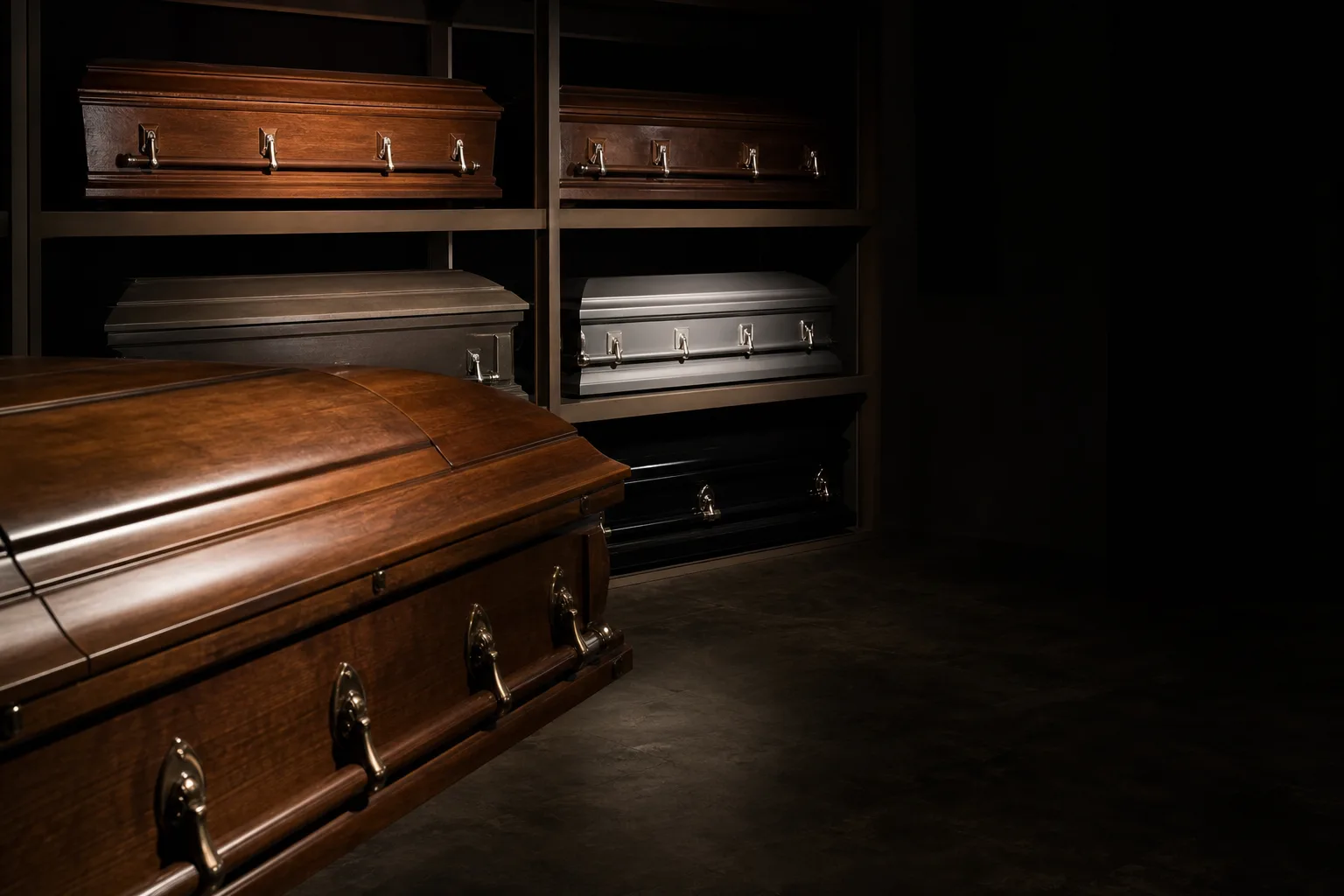
What to verify before ordering a casket or cremation container from a third party: delivery timing, interior measurements, crematory limits, and the fees a funeral home may not charge.
Buying the container separately from the services is legal everywhere in the United States, and it is common enough that most funeral homes have a routine for it. The routine still varies. Some staff will meet the freight truck without comment, and some will hand you a form you did not expect. The difference between a smooth handoff and a bad morning is almost always something checked in advance, usually a measurement or a delivery window, and almost never the price you paid. Here is what a careful buyer confirms before the money moves.
1. The delivery date, in writing, against the service date
Online and third-party sellers usually quote one to three business days for ground freight on a casket, faster if they hold stock near you, slower for anything built to order or finished in an unusual wood. Get the promised arrival date in writing, get the carrier's name, and get a tracking number as soon as one exists. Then ask the funeral home what time on that date somebody will be on site to sign. A container that arrives at four in the afternoon on the day of a ten o'clock service is a container that did not arrive.
2. Whether anyone has to be present to receive it
The funeral home cannot require you, or a family member, to stand at the loading dock while the truck unloads. It also cannot require you to be there to inspect. That said, somebody should look at the box before the driver leaves, because freight damage claims get much harder once the delivery receipt is signed clean. Ask the seller who files the claim if a corner is crushed, ask whether a replacement ships overnight, and ask what the fallback is. Reputable sellers have answered these questions many times.
3. The interior measurements, not the exterior ones
Casket listings often give outside dimensions, which tell you what fits in the vault and the grave, and say less about what fits inside. For a large or tall person, ask for interior length, interior width at the shoulder, and interior depth. Standard adult caskets run about seventy-nine inches inside; oversize models step up in width by two-inch increments. Confirm the number with the funeral director before ordering, because a casket that is an inch short is not a problem anyone can fix on the day.
4. What the cemetery's outer burial container will accept
If the grave requires a vault or a grave liner, and most maintained cemeteries do, the vault has fixed inside dimensions. An oversize casket needs an oversize vault, and an oversize vault sometimes needs a wider grave space. Give the cemetery the exterior width and length of the casket you intend to buy, in that order, and let them confirm the vault model before you order. This is a five-minute call that prevents the single most expensive surprise in the whole transaction.
5. What the crematory will actually burn
Crematories set their own rules about materials and about chamber size, and those rules are not negotiable. Cardboard, unfinished pine, and plywood alternative containers are standard and widely accepted. Metal hardware, thick lacquer, plastic liners, and hinges may not be. Ask for the maximum width and weight the retort accepts, ask whether the container has to be rigid enough to be handled on a charging table, and ask whether a bottom board is required. A homemade box built to those three answers will be accepted.
6. Whether a homemade box holds together loaded
Weight is the test. A wooden box carrying an adult must survive being lifted, carried, slid, and set down, sometimes by people who did not build it. Screws rather than nails, a bottom that is fastened to the sides rather than resting inside them, cleats under the base, and handholds that are structural rather than decorative all matter. Ask the funeral director to look at it before the day. Most will, and most have a clear opinion.
7. The fees the funeral home may not charge
The Federal Trade Commission is responsible for the rule governing funeral sales, and under it a provider must accept a casket or alternative container you bought elsewhere without charging a handling fee, a storage fee, or any surcharge for using it. Nor can it condition its services on buying the box from its own selection room. What it may charge is its standard basic services fee and the itemized charges for what it actually does. That distinction is worth reading closely on the price list.
8. The itemized price list, before you order anything
You are entitled to the general price list on request, in person, and the casket price list before you are shown caskets. Compare the outside seller's total, delivered, against the funeral home's line item for the same or a similar model. Sometimes the difference is large. Sometimes shipping closes it. Either way, the comparison is only meaningful once you have both numbers in front of you in itemized form.
9. Who takes the container if plans change
Ask the seller about returns before the sale, specifically whether an unused container can be sent back, who pays return freight, and what restocking runs. Ask the funeral home how long it will hold a delivered container if the service is postponed. Both answers are usually reasonable, and both are much easier to obtain in advance than after the fact.
None of this takes long. A short list of measurements, one call to the cemetery, one to the crematory, and a written delivery date cover nearly every way an outside purchase goes wrong, and buyers who make those calls generally find the rest of it straightforward.